Sheet Metal Components for Industrial Fans: From Deep Drawing to Dimensional Inspection
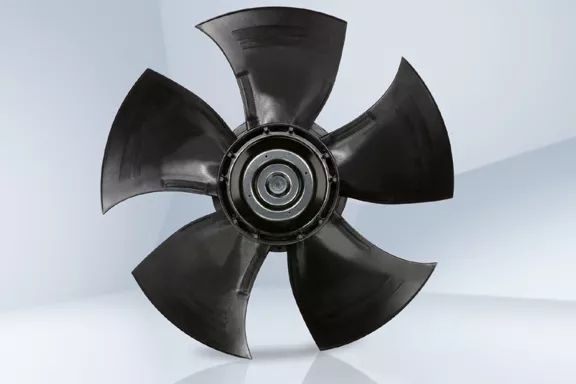
An industrial fan is a component that, once installed, has to run without interruption for years — often under operating conditions that include high temperatures, continuous vibration, and repeated mechanical loads.
Whether it's an axial fan integrated into a heat exchanger or a ventilation system for a production plant, the reliability of the entire assembly depends largely on two elements: the rotor and the hub structure. These components are manufactured from heavy-gauge steel sheet, processed through a production cycle that combines cold forming, precision machining, welding, and quality control.
This is one of the application areas where Minifaber operates, applying its sheet metal expertise to a market that's particularly demanding precisely because it combines substantial material thickness with tight dimensional tolerances.
Why Industrial Fans Require Heavy-Gauge Steel Sheet
The rotor and hub structure of an industrial fan aren't simple stamped parts — they're structural components subjected to continuous mechanical stress, often in environments with high operating temperatures where operating conditions leave no margin for error. That's exactly why they're built starting from heavy-gauge steel sheet.
Working with heavier gauges, though, brings specific challenges that need to be addressed head-on — challenges Minifaber is consistently equipped to handle.
Material deformation during forming is harder to control on thick sheet than on thin sheet, due to the risk of cracking, uneven springback, or dimensional drift. That risk scales up proportionally with thickness, requiring production processes capable of managing these conditions reliably.
Manufacturing these components demands know-how that goes beyond other sheet metal applications: it's not enough to have the base technologies for deep drawing, welding, and turning — Minifaber has to know how to develop and apply them specifically for the thickness and tolerances an industrial fan requires.
Where Industrial Fans Operate: Application Areas
Industrial fans are used across a wide range of settings, wherever large volumes of air need to move continuously and reliably.
In heat exchangers, for example, the axial fan drives the airflow through the heat exchange coils — a job that demands constant flow rates and vibration-free operation, or the entire system's efficiency takes a hit. The same principle applies to industrial cooling systems, extraction systems in production processes, and cooling towers, where the fan often operates at high temperatures and in the presence of humidity or corrosive agents.
These application areas differ widely from one another, but they share one thing in common: the fan isn't an accessory — it's a genuinely critical process component, and any malfunction compromises the efficiency of the entire system it's connected to. That's why manufacturing its core components — the rotor and hub structure above all — leaves no room for compromise on dimensional precision or starting material quality.
The Production Cycle: From Deep Drawing to Finished Component
Deep Drawing and Ironing
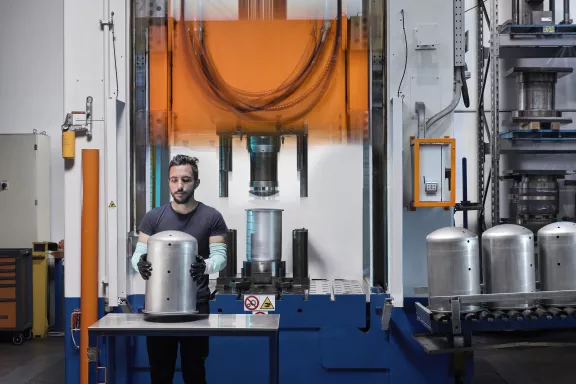
The production cycle begins with deep drawing and ironing operations, which have to achieve the tight geometric, form, and dimensional tolerances called for on the drawing, along with material strength and good surface quality. This is the most delicate stage of the entire process: an error at this step carries through every downstream operation, leaving the finished component non-compliant for its intended use.
Industrial Washing
Once forming is complete, the components go through a thorough industrial washing process. This step isn't optional: it removes the spent forming oil that turns into oily sludge after deep drawing and ironing. If not fully removed, this residue compromises the subsequent welding stage, generating dangerous defects such as cracking, porosity, inclusions, incomplete fusion and joint penetration, as well as arc instability and spatter.
Welding the Centering Bushing and Flange
Once surface preparation is complete, Minifaber welds the centering bushing: a component that ensures correct mating between the fan's different parts and the precision of the final assembly. During fan operation, the welded joint is subjected to fatigue and high dynamic loads, so the weld has to be executed to the highest standard, in full compliance with the relevant reference codes. The cycle is completed with the welding of the flange, which closes out the component's structure.
Precision Turning
After welding, the component is machined on a turning center developed and tooled specifically for this application. It's not a general-purpose turning center: the decision to develop dedicated tooling stems from the need to meet very tight dimensional, form, and geometric tolerances that a standard process couldn't guarantee with the same reliability across repeated production runs over time.
100% Dimensional Inspection
The final stage of the production cycle is dimensional inspection, carried out using dedicated measuring equipment designed specifically to verify every geometric characteristic of the component. Unlike sample-based inspection, every single unit produced undergoes 100% inspection — a choice that reflects just how much, in this sector, an undetected dimensional error can turn into an operational problem once the component is already installed and running.
Coating
The cycle closes with coating, which protects the component from corrosion and ensures it holds up under the demanding, continuous operating conditions typical of industrial ventilation systems.
Why Choose Minifaber for Industrial Ventilation
Anyone designing or manufacturing industrial fans should weigh a few factors beyond basic technology availability when evaluating a sheet metal component supplier. The first is the ability to work heavy-gauge steel sheet while holding tight tolerances: not every cold-forming supplier has developed processes specifically for this combination of requirements, which often sits closer to heavy fabrication than to thin-gauge sheet metal work.
The second is the availability of dedicated tooling, like turning centers built specifically for the application — a choice that requires upfront investment, but that delivers repeatable precision batch after batch, a non-negotiable condition for components meant to run for years without major maintenance.
The third — and perhaps the most important — is the ability to integrate the entire production cycle, from cold forming through quality control, under a single point of accountability, so the component never has to move between multiple suppliers to complete its different processing stages.
For Minifaber, the added value lies exactly in having a dedicated production line, developed together with the client, that reduces upstream the risk of a defect slipping in between one step of the chain and the next.
When a component has to operate under demanding conditions for years, its reliability doesn't depend on any single well-executed operation — it depends on the consistency of the entire production process, from raw material to final testing. Integrating every stage into a single dedicated line reduces the handoff points where a defect could creep in.
In an industry where the cost of unplanned downtime almost always outweighs the cost of the component itself, choosing a sheet metal supplier isn't a secondary decision — it's a variable that directly affects the outcome of the entire order, every bit as much as material selection or component sizing.
Have a project that requires heavy-gauge sheet metal components for industrial fans?
Contact Minifaber: our technical team can support you from the design phase onward, helping evaluate materials, processes, tolerances, and the production solutions best suited to your needs.