MOCA and Food-Grade Sheet Metal: How Regulations Guide the Fabrication of Food Equipment Professional Components
When a sheet metal component is meant to come into contact with food, the project no longer starts from a technical drawing alone. It has to account for the regulations from day one.
In the Food Equipment Professional sector, MOCA compliance (Materials and Objects in Contact with Food) is not a requirement to check once fabrication is complete. It is a constraint that shapes material selection and material control upstream.
What Is the MOCA Regulation, and Why Does It Apply to Sheet Metal?
The MOCA regulation governs all materials and objects intended to come into direct or indirect contact with food: from packaging to industrial equipment, down to the internal components of machines that prepare or process food. The underlying principle is as simple to state as it is demanding to achieve. The material must not release substances into the food or compromise its hygiene and safety in any way, and this must hold true over time, even after years of use and repeated cleaning.
This regulation is, in turn, closely tied to the GMP (Good Manufacturing Practices) regulation. While MOCA sets the safety requirements for the finished product, GMP sets the requirements for the production process, ensuring that the entire production line operates in a hygienic and, above all, controlled manner.
For a sheet metal component, this means compliance is not just about the alloy chosen. It covers the entire production cycle that takes the part from raw sheet to finished component.
MOCA Requirements for Stainless Steel Components
The MOCA regulation clearly lists the materials, both metallic and non-metallic, that may come into direct contact with food.
The reference material for Food Equipment Professional components is austenitic stainless steel, typically AISI 304 and 316, along with the AISI 304L and AISI 316L variants. It is chosen for its corrosion resistance, even with frequent washing and aggressive alkaline cleaning agents such as dishwasher detergents.
Choosing the right alloy, however, is only the starting point. As the material goes from sheet to finished component, it undergoes a metallurgical transformation that can alter some of its physical properties. The same applies to fusion welds.
For this reason, the MOCA regulation requires a migration test on the finished part, to verify that chemical elements do not transfer into the food. For austenitic stainless steels, the test verifies that chromium, nickel, and manganese are not released in amounts exceeding 0.1 ppm (parts per million) each.
What the MOCA regulation does not address is the geometry of the part, which falls under the UNI EN 1672-2 standard, where hygiene and cleanability requirements are specified.
A compliant surface under UNI EN 1672-2 must be as free as possible of porosity, discontinuities, and stagnation points where food residues can accumulate. Every surface imperfection is potentially a hygiene-critical point, even before it is an aesthetic one, and it is a spot where food can stagnate and bacteria can develop.
MOCA: Not Only Stainless Steel
Austenitic stainless steels are not the only metals that can come into contact with food.
The MOCA regulation in fact covers other metals commonly found in our kitchens, such as ferritic stainless steels like AISI 430. These are used for induction cookware, since their magnetic properties are what makes induction heating work.
A further step forward is AISI 441, which is better suited to welding, and above all AISI 444, which is both weldable and as corrosion-resistant as AISI 316.
Other metals also fall under the MOCA regulation, such as aluminum and copper, the latter subject to specific restrictions.
Why Fabrication Also Determines Compliance
The choice of fabrication process becomes an integral part of regulatory compliance, not just a process decision.
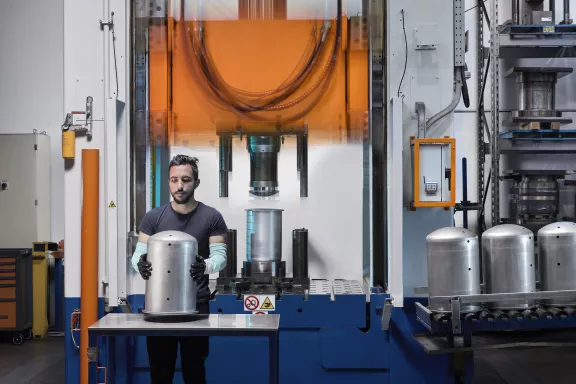
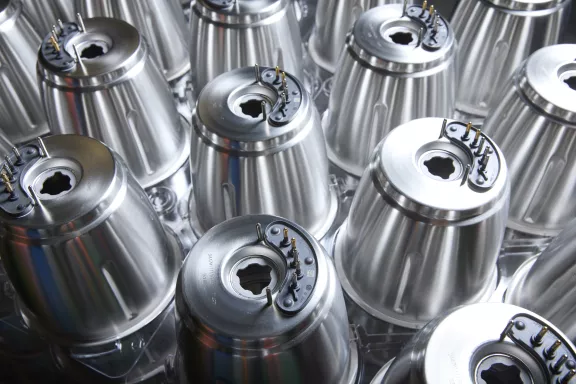
A recurring example in the sector is hollow components, such as the trays that hold food during processing. Producing them by deep drawing, starting from a disc or a piece of sheet metal, yields the desired shape without the joints that assembling multiple parts would require. Fewer joints mean fewer critical points to control from a hygiene standpoint.
The same principle guides the choice of type of welding when two components must be joined, such as a tray and the machine deck on which it is installed. Here, laser welding produces precise seams with very limited thermal alteration of the material.
Polishing is another critical step. A perfectly polished weld seam, so well blended that it is practically invisible against the surrounding surface, is not just an aesthetic achievement. It is what makes the joint as cleanable as the rest of the component, keeping it from becoming an accumulation zone over time.
The Surface Treatment Cycle Geared Toward Hygienic Compliance
Hygienic compliance does not end with forming. The component goes through a treatment cycle that starts with grinding and includes degreasing, pickling, and passivation, followed by an optional polishing step depending on the required finish.
Each phase of this cycle serves a specific purpose in achieving final compliance. Pickling removes the surface impurities generated by earlier processes, while passivation restores and stabilizes stainless steel's natural protective layer, chromium oxide, strengthening its corrosion resistance precisely where the material is most exposed: the surface in contact with food.
Compliance Covers the Entire Cycle, Not Just the Sheet Metal
The MOCA compliance of Food Equipment Professional equipment is not limited to the individual sheet metal component. It covers the entire assembly, including the complementary processes that go into the finished product, from stamping to laser cutting, from punching to bending, and the different welding technologies used to join components and inserts. It takes the same level of attention at every production stage, because regulatory compliance holds only if it stays constant from the first step of the cycle to the last.
As noted earlier, the MOCA regulation is closely tied to the GMP (Good Manufacturing Practices) regulation, which sets the requirements for the production process, ensuring that the plant operates in a controlled and hygienic way.
The entire production cycle must be described and backed up by internal documentation. This takes the form of a technical file describing every process in the cycle, such as deep drawing, shearing, bending, laser cutting, grinding, pickling and passivation, and polishing. The GMP regulation also requires documenting the substances, chemical mixtures, and chemical products used in these processes, such as stamping lubricants, pickling and passivation acids, washing detergents, and polishing compounds. A safety data sheet and a technical data sheet must be available for each of them.
Minifaber follows this logic, working on Food Equipment Professional components with direct control over every stage of the process, from alloy selection to final finishing. Readers who want to explore the full offering for the sector, from co-design to supply chain management, can refer to the dedicated Food Equipment Professional sector page on the Minifaber website.
Minifaber is your partner for sheet metal fabrication and finished products