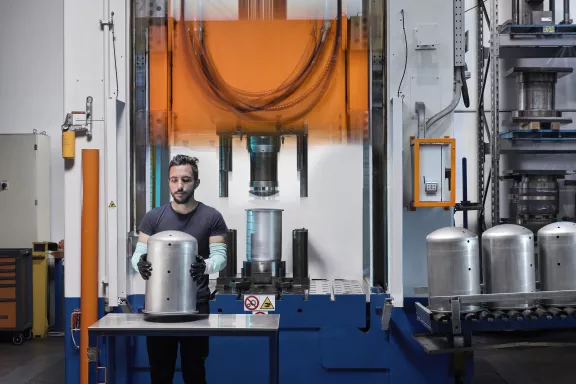
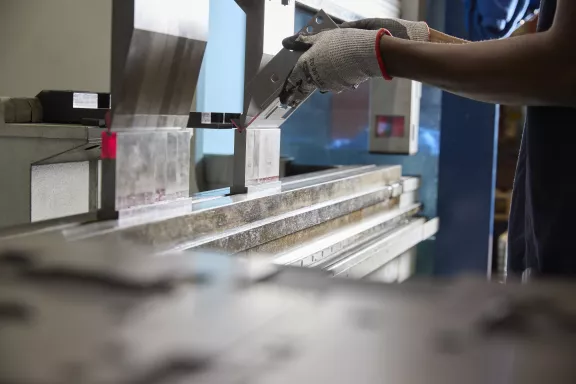
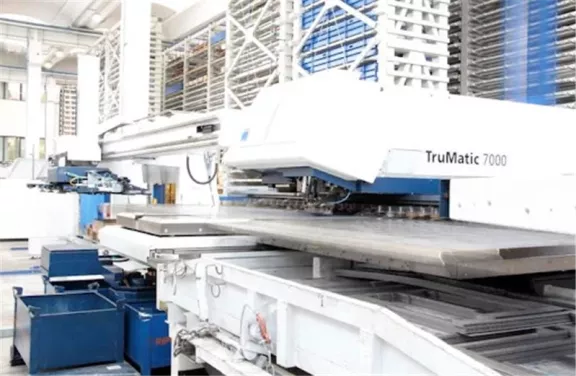
Punching: advantages, limitations, and comparison with laser cutting
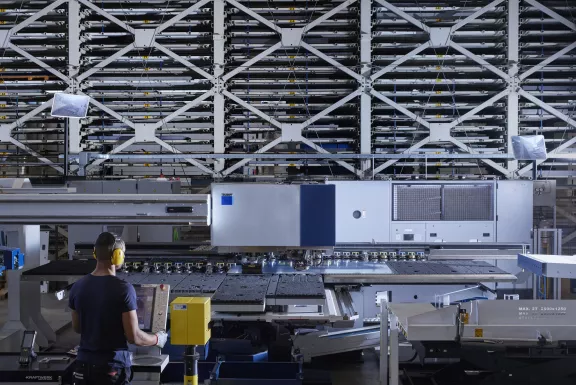
In the field of sheet metal working, punching is a well-established and highly productive solution, which is particularly appreciated for the creation of holes, shapes, and repetitive processes on flat metal components.
It should be emphasized that it is not only important to understand what punching is, but in light of the spread of laser cutting, it is also useful to compare the two solutions in order to understand when it is better to choose punching and when, on the other hand, laser cutting is more suitable, or in which cases the integration of the two technologies offers the best result.
What is metal punching?
Metal punching is a mechanical process that allows sheet metal to be sheared or perforated through the combined action of a punch and die. The material is deformed and cut by the concentrated force exerted by the punching machine.
The tool assembly generally consists of:
- punch,
- die,
- sheet metal press.
In addition to simple drilling, punching also allows for:
- shaping, profile cutting
- small folds,
- shallow embossing on sheet metal,
- flanging,
- threading.
These characteristics make punching a particularly versatile technology for functional and semi-structural components.
CNC punching: precision and automation
Today, punching mainly uses automatic numerically controlled machines (CNC punching), which use standard or special tools depending on the final design.
CNC programming allows for:
- high precision,
- dimensional repeatability,
- speed of execution,
- integration with other processes.
At Minifaber, punching is performed on latest-generation punching machines, selecting the most suitable machine for each job based on the material, thickness, and geometry of the piece.
The advantages of sheet metal punching
Punching continues to be one of the most requested processes on the market thanks to a series of technical and production advantages.
High productivity
For repetitive processes and standard geometries, punching allows for very short cycle times, making it particularly efficient in medium-high production runs.
Operational versatility
With a single technology, it is possible to combine multiple processes on the same piece, reducing intermediate steps and handling.
Competitive costs
When the number of pieces increases, punching allows unit costs to be kept down, especially for standardized processes.
Wide compatibility with materials
Punching can be applied to:
- ferrous materials,
- stainless steel,
- aluminum,
- copper,
- brass,
- special alloys.
The limitations of punching: what are they?
Alongside its advantages, punching also has some limitations that must be evaluated when choosing the technology.
- Very complex geometries or free profiles may be less efficient than laser cutting.
- High thicknesses or particularly hard materials may require more restrictive parameters.
For these reasons, punching is not always the best solution, but should be considered as part of a broader technical assessment.
Punching vs. laser cutting: a comparison
The comparison between laser cutting and punching should not be seen as an either/or choice, but rather as complementary processes.
When punching is advantageous
- Repetitive and precise perforations
- Standard shapes
- Medium-high production
- Integration of multiple processes on the same piece
- Creation of small folds, stampings, and threads
When laser cutting is advantageous
- Complex and variable geometries
- Small series or prototypes
- Frequent design changes
- High design freedom
Combined punching and laser cutting
At Minifaber, the presence of punching machines combined with laser cutting allows us to exploit the advantages of both technologies in the same production cycle.
This integration not only improves productivity, but also allows us to become more flexible and optimize the quality of the finished piece, while also reducing overall time and costs.
The most effective combination is always chosen based on the technical specifications of the component and the customer's production objectives.
Punching processes at Minifaber
Minifaber performs metal punching processes on small and large quantities, thanks to a constantly updated fleet of machines and know-how gained through collaboration with international companies.
The company is structured to handle:
- sheet metal punching in general
- stainless steel punching
- copper and copper alloy punching, such as brass
- aluminum punching
- ferrous materials and special alloy punching.
Each process is evaluated according to the material, thickness, geometry, and intended use of the component, suggesting the most effective technological solution.
Punching as part of an integrated process
Punching is one of the key technologies in cold sheet metal working processes. At Minifaber, it is integrated with bending, cold stamping, and welding to offer complete and consistent solutions, reducing production complexity and improving the reliability of the final result.